Ethical Hacking & Attack Surface Validation Lab
Independent Project / Cybersecurity / Ethical Hacking / Attack Surface Management
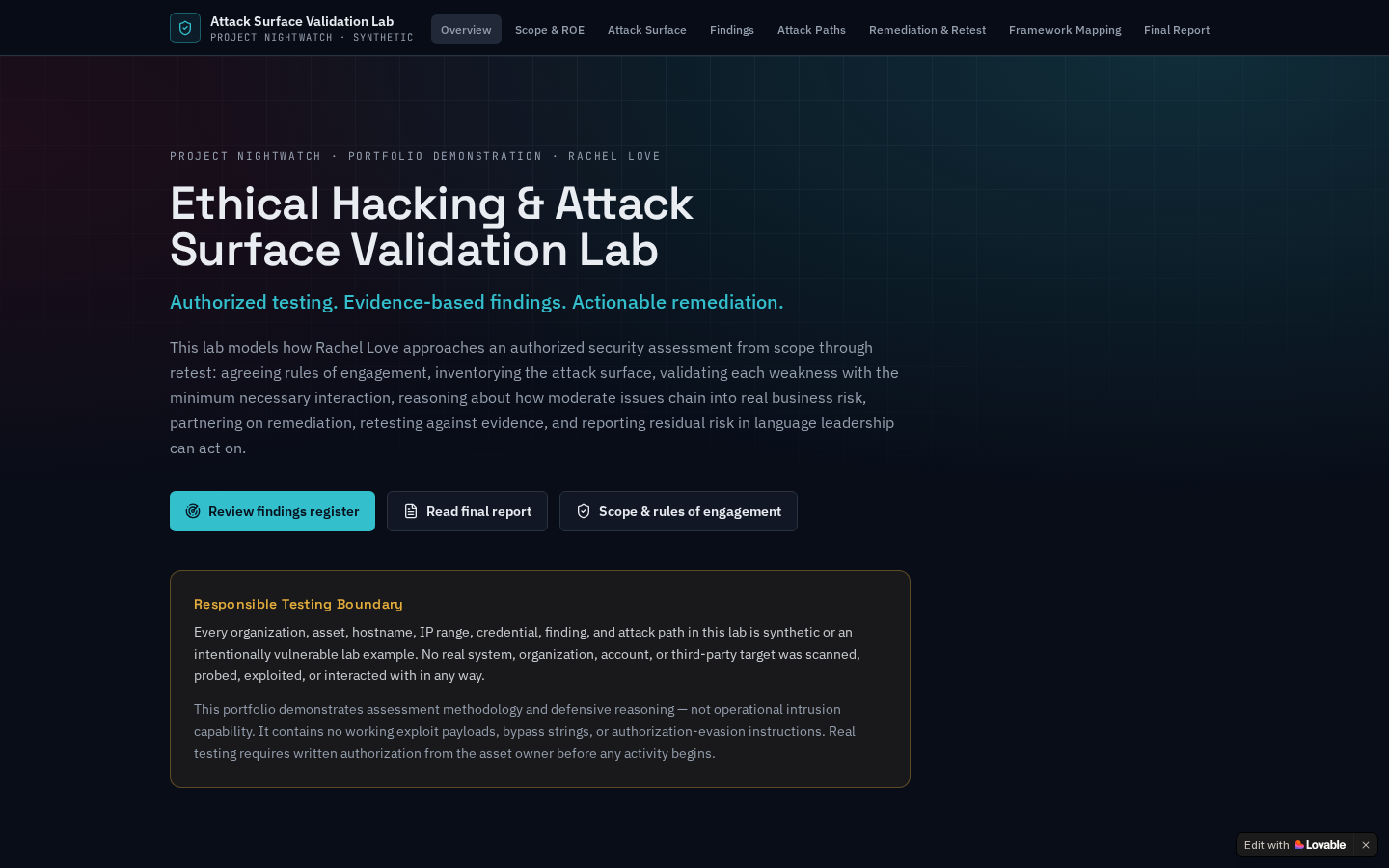
Recruiter-facing ethical hacking and attack surface validation lab demonstrating an authorization-first security assessment lifecycle using entirely synthetic data: scope and rules of engagement, attack-surface inventory, validated findings, attack-path reasoning, risk prioritization, remediation, retesting, framework mapping, and executive reporting.
Problem or objective
Ethical hacking is often reduced to vulnerability discovery. This project demonstrates the harder professional work around explicit authorization, evidence quality, business-impact framing, attack-path analysis, remediation ownership, retest discipline, residual risk, and leadership communication.
Rachel's role
Sole designer, security analyst, solution-architecture thinker, and full-stack portfolio builder responsible for requirements, synthetic engagement model, scope and rules of engagement, attack-surface model, findings, attack paths, remediation and retest workflow, framework cross-references, UI/UX, testing, documentation, and public release.
- Define the synthetic engagement model, authorization boundaries, and rules of engagement
- Build the in-scope attack-surface inventory and asset exposure model
- Document validated findings with evidence quality and business-impact framing
- Model illustrative attack paths and prioritize by risk rather than raw severity
- Design the remediation ownership and retest verification workflow
- Map findings to OWASP Top 10, CWE, MITRE ATT&CK, and NIST CSF 2.0
- Produce an executive reporting view with residual risk framing
Process
- 01Authorization, scope, and rules of engagement
- 02Attack-surface inventory
- 03Validated finding documentation
- 04Attack-path reasoning
- 05Risk prioritization and business impact
- 06Remediation ownership
- 07Retest verification
- 08Framework mapping
- 09Executive reporting and residual risk
Architecture components
Engagement governance
- Authorization record
- Scope and rules of engagement
- Testing windows and boundaries
Assessment model
- Attack-surface inventory
- Validated findings
- Illustrative attack paths
Response workflow
- Risk prioritization
- Remediation ownership
- Retest verification and residual risk
Framework mapping
- OWASP Top 10
- CWE
- MITRE ATT&CK (conceptual)
- NIST CSF 2.0
Case study
Business problem
Finding a vulnerability is the easy part. Organizations need assessments that begin with explicit authorization, produce evidence a defender can act on, frame impact in business terms, assign remediation ownership, and prove closure through retesting. This lab models that full lifecycle on synthetic data.
Authorization and rules of engagement
- Written authorization boundary defined before any assessment activity is modeled
- In-scope and out-of-scope assets stated explicitly
- Testing windows, escalation contacts, and stop conditions documented
- Minimum-necessary interaction principle applied throughout
Attack surface and validated findings
- 8 in-scope synthetic assets inventoried with exposure context
- 12 validated findings with reproducible evidence framing
- Severity paired with business impact rather than score alone
- Non-exploitable observations separated from confirmed weaknesses
Attack-path reasoning
- 3 illustrative attack paths chaining individually lower-severity findings
- Path narratives written at the concept level with no operational payloads
- Chokepoints identified where a single control breaks multiple paths
Remediation and retest discipline
- Named remediation ownership for each finding
- 9 findings remediated or closed
- 9 passed retests recorded with verification notes
- Residual risk stated openly for anything not fully closed
Framework mapping
- OWASP Top 10 category cross-references
- CWE identifiers for weakness classification
- MITRE ATT&CK techniques referenced conceptually for defender context
- NIST CSF 2.0 function alignment for leadership reporting
Responsible portfolio boundaries
- Synthetic organizations, assets, identities, findings, and attack paths only
- No real target scanned, probed, exploited, or contacted
- No exploit payloads, bypass strings, credential theft, or persistence techniques
- Not a client assessment, certification, compliance attestation, or production penetration test
Engineering quality
- TypeScript, React 19, and TanStack Start with typed content modules
- Zod-validated assessment data structures
- Vitest coverage over findings, paths, and mapping data
- Typecheck clean, lint clean, successful production build
Tools and technologies
- TypeScript
- React 19
- TanStack Start
- Tailwind CSS v4
- shadcn/ui
- Recharts
- Zod
- Vitest
- OWASP Top 10
- CWE
- MITRE ATT&CK (conceptual)
- NIST CSF 2.0
Security and ethical considerations
- Entirely synthetic organizations, assets, identities, findings, and attack paths
- Authorization-first framing: no real target was scanned, probed, exploited, or contacted
- No working exploit payloads, bypass strings, or credential-theft techniques included
- No persistence, destructive actions, or authorization-evasion instructions
- No certification, compliance attestation, or production penetration test is claimed or implied
Outcome
A public, documented security-assessment portfolio lab with 8 in-scope synthetic assets, 12 validated findings, 3 illustrative attack paths, 9 remediated or closed findings, 9 passed retests, OWASP Top 10, CWE, MITRE ATT&CK, and NIST CSF 2.0 analytical mappings, and an executive-reporting workflow. The app is intentionally non-operational.
Portfolio demonstration using synthetic organizations, assets, identities, findings, and attack paths only. It does not represent a real client assessment, certification, compliance attestation, or production penetration test. No working exploit payloads, bypass strings, credential-theft techniques, persistence, destructive actions, or authorization-evasion instructions are included.