Oracle Secure Data Engineering Lab
Independent Project / Data Engineering / Oracle / Database Security
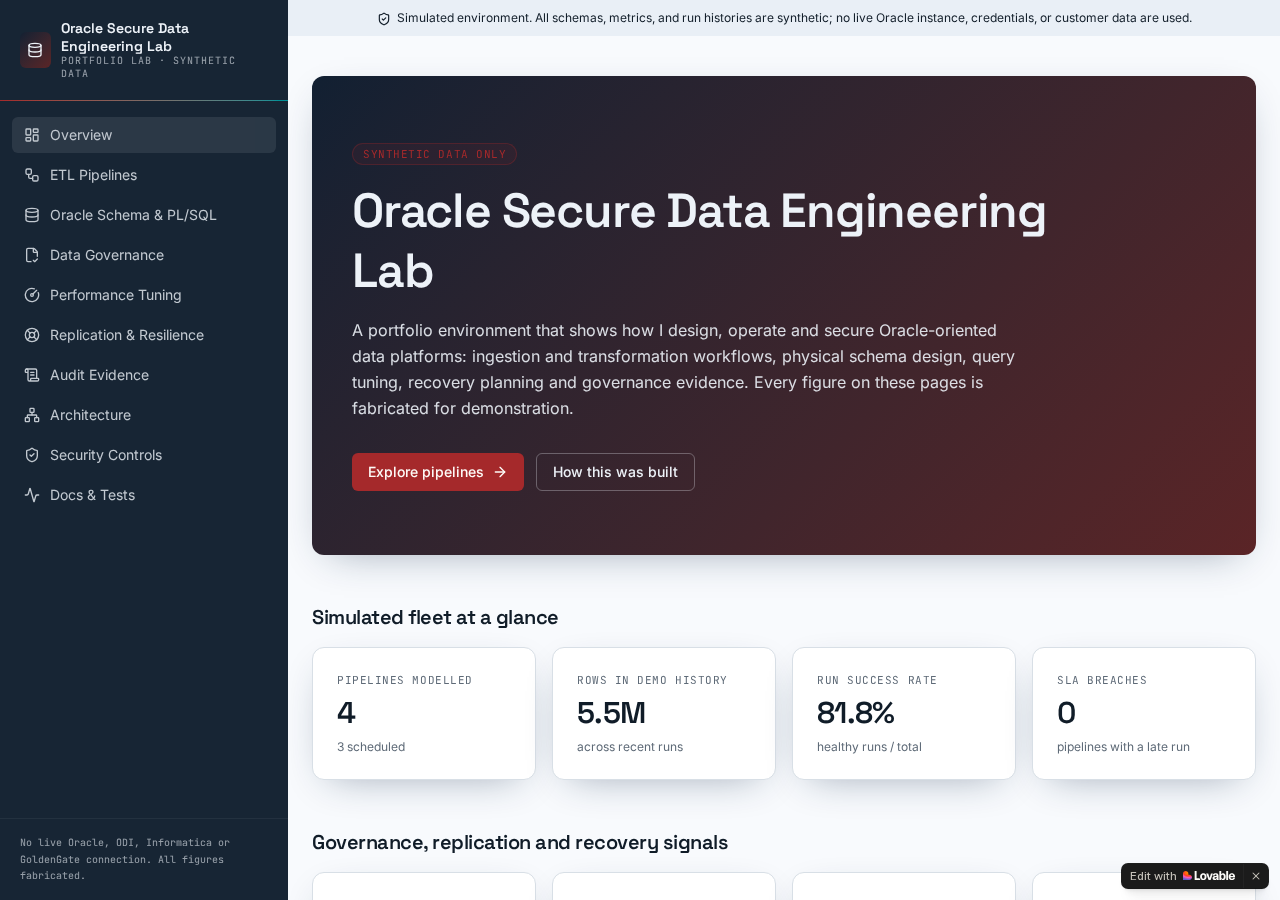
A recruiter-facing portfolio lab demonstrating secure Oracle-oriented data engineering across ETL pipelines, PL/SQL and schema design, data governance, performance tuning, replication and resilience, audit evidence, and security controls.
Problem or objective
Enterprise data platforms need reliable ingestion, transformation, governance, performance, resilience, and auditable security controls. These are usually treated as separate concerns, which makes it hard to see how a change in one area affects the others.
Rachel's role
Sole designer and full-stack builder responsible for the data-platform model, ETL and governance workflows, Oracle schema and PL/SQL patterns, tuning and resilience content, security and audit evidence design, testing, and public documentation.
Process
- 01Platform requirements and recruiter-facing positioning
- 02Layered data-platform architecture design
- 03Synthetic ETL pipeline and run-history modeling
- 04Oracle schema and PL/SQL pattern design
- 05Data governance, quality checks, and stewardship
- 06Performance tuning and wait-class analysis workflow
- 07Replication, backup, RPO/RTO, and disaster-recovery runbooks
- 08Audit evidence and security-control documentation
- 09Testing, linting, and production build verification
Architecture components
Source and ingestion
- Source systems
- ETL and orchestration concepts
- Stage timing and run history
Oracle data layer
- Schema design patterns
- PL/SQL packages and procedures
- Partitioning and indexing concepts
Governance and quality
- Data-quality checks
- Source-to-target reconciliation
- Stewardship and ownership
Operations and reporting
- Query tuning workflow
- Replication lag budgets
- Backups, RPO/RTO, DR runbooks
- Analytics and reporting views
Case study
Business problem
Enterprise data platforms need reliable ingestion, transformation, governance, performance, resilience, and auditable security controls at the same time. This lab models them as one connected platform so a pipeline change, a tuning decision, and an audit requirement can be reasoned about together.
Architecture approach
A layered data-platform design connects source systems, ETL and orchestration concepts, Oracle schema and PL/SQL patterns, governance, monitoring, and analytics and reporting. Each layer states what is implemented in the lab versus what would exist in a production Oracle estate.
Data engineering
- Modeled ETL pipelines with run history and stage timing
- SLA tracking across scheduled and ad hoc runs
- Data-quality checks with pass, warn, and fail outcomes
- Source-to-target reconciliation views
- Data stewardship and ownership assignments
Performance and resilience
- Query tuning workflow from symptom to plan review to change
- Wait-class and execution-plan analysis concepts
- Replication lag budgets and lag monitoring
- Backup strategy with RPO and RTO targets
- Disaster-recovery runbooks with role-by-role steps
Security and governance
- Privileged-action audit evidence patterns
- Access and security-control concepts documented by area
- Synthetic datasets throughout
- Explicit implemented-versus-production boundaries on every control
Engineering quality
- 25 of 25 Vitest tests passing on the latest verified run
- Lint clean with 0 errors and only pre-existing Fast Refresh warnings
- Successful production build
- TypeScript throughout with typed domain modules
Tools and technologies
- TypeScript
- React
- TanStack Start
- Tailwind CSS
- Vitest
- ESLint
- Prettier
Security and ethical considerations
- Synthetic data only; no live Oracle instance, credentials, or customer data
- Oracle, ODI, GoldenGate, and Informatica references are architecture demonstrations and concepts, not live integrations or vendor affiliation
- Privileged-action audit evidence is modeled to show accountability patterns, not real audit records
- Access and security controls are documented with explicit implemented-versus-production boundaries
- No secrets, connection strings, or environment credentials in the public repository
Outcome
A public, documented lab that shows secure Oracle-oriented data engineering end to end, with 25 of 25 Vitest tests passing, lint clean apart from pre-existing Fast Refresh warnings, and a successful production build.
Portfolio lab using synthetic data only. There is no live Oracle instance, credentials, or customer data. Oracle, ODI, GoldenGate, and Informatica references are architecture demonstrations and concepts, not live integrations or vendor affiliation.